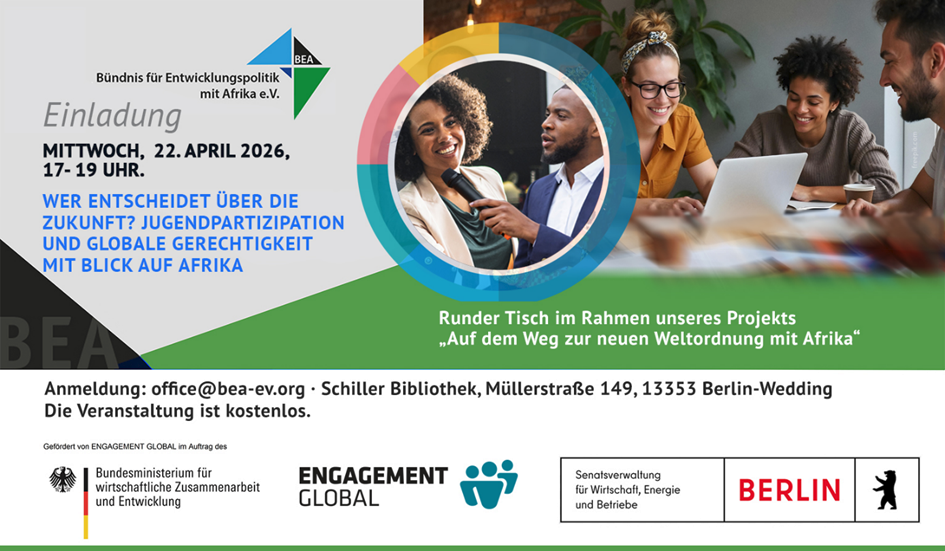
Einladung: Runder Tisch – BEA e.V.
Thema: Wer entscheidet über die Zukunft? Jugendpartizipation und globale Gerechtigkeit mit Blick auf Afrika
Wann: Mittwoch, den 22. April 2026, 17- 19 Uhr.
Ort: Schiller- Bibliothek, Müllerstraße 149, 13353 Berlin und Online via Zoom
Sprache: Deutsch/Englisch mit Simultanübersetzung
Kostenlose Teilnahme und Verpflegung
Bei der Anmeldung bitte erwähnen, ob Sie online oder in Präsenz teilnehmen.
Anmeldungen bis zum 21. April 2026 unter: office@bea-ev.org
Liebe Akteur:innen der Politik und der Zivilgesellschaft,
liebe Engagierte,
sehr geehrte Damen und Herren,
Die Zukunft gehört der heutigen Jugend – und doch bleibt ihre Stimme oft ungehört, wenn es um Entscheidungen geht, die unsere Welt von morgen prägen.
In den letzten Jahrzehnten haben junge Menschen weltweit gezeigt, dass sie aktiv an der Gestaltung unserer Zukunft teilhaben wollen. Politische Bewegungen der Generation Z in Afrika, Europa und Amerika setzen sich mit Nachdruck gegen Machtmissbrauch, Klimakrise und Ungleichheit ein. Ihre Botschaft ist klar: Die Jugend ist mit der bisherigen ‘Betreuung’ ihrer Zukunft unzufrieden.Viele junge Menschen wollen nicht länger Zuschauer:innen sein. Doch die Generation Z steht sowohl in den alten Industrieländern des überkommenen, unter Konkurrenzdruck geratenen Zentrums als auch in vielen Ländern der “Peripherie” vor der neuen Situation, dass es ihnen ohne tiefgreifende gesellschaftliche Veränderungen mehrheitlich wirtschaftlich und sozial schlechter gehen wird, als ihren Eltern. Diese neue Situation nährt nicht nur das Streben nach partizipationsorientierten und solidarischeren Veränderungen der Weltgesellschaft, sondern auch Resignation, aber bei vielen auch Zustimmung zu autoritären und rassistischen, suprematistischen Krisenlösungsversprechen: Ein “First” für die vermeintlich eigene Gemeinschaft gegen die “viel zu vielen” Anderen.
Dieses widersprüchliche Streben nach Veränderung, besonders stark in Afrika, ist Teil einer globalen Entwicklung. Die Welt befindet sich im Wandel: Machtverhältnisse verschieben sich, etablierte Regeln wanken, und der Wettbewerb um Ressourcen erzeugt neue Spannungen – selbst unter ehemaligen Verbündeten. Amerika, Europa und Asien konkurrieren um Afrika, um ihren Bedarf an Rohstoffen und natürlichen Ressourcen zu sichern. Gleichzeitig sind viele afrikanische Länder weiterhin gezwungen, die Last hoher Schulden zu tragen.
Doch genau in diesem Kontext liegt eine große Chance. Afrika kann eine zentrale Rolle beim Aufbau einer nicht nur neuen, sondern auch besseren Weltordnung spielen – vorausgesetzt, die Solidaritätsorientierten der jungen Generation finden wirksame Wege, sich Gehör zu verschaffen und mitzuentscheiden.
Leitfragen:
- Was bedeutet „Globale Gerechtigkeit“? Wie können Jugendliche wirkungsvoll für sie eintreten?
- Was müsste sich auf politischer und wirtschaftlicher Ebene ändern, damit junge Menschen dauerhaft mitentscheiden können?
- Wie können junge Menschen aus Afrika stärker in globale Entscheidungsprozesse eingebunden werden – nicht nur als „Betroffene“, sondern als Akteur:innen?
- Welche Bildung wollen wir und welche Finanzierungswege für gute Bildungssysteme finden wir, damit junge Menschen wirksamer mitsprechen und über ihre Zukunft mitentscheiden können?
- Wie könnten Allianzen zwischen afrikanischen und europäischen Jugendorganisationen aufgebaut werden, um gemeinsam für globale Gerechtigkeit aktiv zu werden?
Diese Fragen sowie Eure Anliegen würden wir gerne gemeinsam mit folgenden eingeladenen Gästen im Rahmen dieses runden Tisches diskutieren :
- Frau Edith Kiami: News and current affairs, East Africa correspondent Deutsche Welle
- Frau Leonie Back: Mitglied des Landesvorstandes der Grünen Jugend Berlin und Delegierte in der Bundesarbeitsgemeinschaft Globale Entwicklung der Grünen
- Herr Blaise Mbuh: Media Pedagogue, Filmproduzent und Gründer des ”Bamenda Film School” in Kamerun
- Bundes der Deutschen Katholischen Jugend (angefragt)
Merkt Euch das Datum vor und seid bei diesem partizipativen Austausch in der Schiller- Bibliothek, Müllerstraße 149, 13353 Berlin und via Zoom dabei!
Programm
Ab 16.45: Ankommen und Begrüßung der Teilnehmenden
17:00-17:10: Begrüßung und Vorstellung des Projekts durch ein Mitglied des BEA e.V.
17:10-17:30: Vorstellungsrunde und Eingangsstatements der Gäste
17:30-18:10: Diskussion zu vorbereiteten Leitfragen und Ihr Inputs
18:10-18:25: Fragen aus dem Publikum
18:25-18:30: Abschlussworte durch ein Mitglied des BEA e.V.
Ab 18:30: Verpflegung und Vernetzung der Teilnehmenden
Diese Veranstaltung ist gefördert von Engagement Global aus Mitteln des Bundesministeriums für wirtschaftliche Zusammenarbeit und Entwicklung (BMZ)
Gemeinsam können wir Schritt für Schritt etwas bewegen.
Wir freuen uns auf Eure Mitwirkung!
Herzliche Grüße
Das Team von BEA e.V. in Kooperation mit NARUD e.V.
———————————
Englisch version
Invitation: Round Table – BEA e.V.
Topic: Who decides the future? Youth participation and global justice with a focus on Africa
When: Wednesday, April 22, 2026, 5–7 PM
Where: Schiller Library, Müllerstraße 149, 13353 Berlin, and online via Zoom
Language: German/English with simultaneous translation
Free participation and catering
Please indicate by registration whether you will attend online or in person.
Registrations by April 21, 2026, at: office@bea-ev.org
Dear actors in politics and civil society,
Dear Dedicated Members,
Ladies and gentlemen,
The future belongs to today’s youth – and yet their voices often remain unheard when it comes to decisions that shape the world of tomorrow.
In recent decades, young people worldwide have shown that they want to actively participate in shaping our future. Political movements of “Generation Z” in Africa, Europe, and the Americas are forcefully opposing abuses of power, the climate crisis, and inequality. Their message is clear: youth are dissatisfied with the way their future has been “managed.” Many young people no longer want to be mere spectators.
However, “Generation Z” faces a new reality both in the old industrialized countries of the traditional, increasingly competitive “center” and in many countries of the “periphery”: without profound societal change, the majority will fare economically and socially worse than their parents. This new situation fuels not only the drive for participatory and more solidarity-oriented changes in global society but also resignation—and, for many, agreement with authoritarian, racist, and supremacist promises of crisis solutions: a “first” for their perceived own community against the “far too many” others.
This contradictory desire for change, particularly strong in Africa, is part of a global development. The world is undergoing transformation: power relations are shifting, established rules are being questioned, and competition for resources generates new tensions—even among former allies. America, Europe, and Asia are competing for Africa to secure their needs for raw materials and natural resources. At the same time, many African countries are still burdened with high debt.
Yet it is precisely in this context that a great opportunity lies. Africa can play a central role in building not just a new, but a better world order—provided that the solidarity-oriented youth of the continent find effective ways to make their voices heard and participate in decision-making.
Key Questions:
- What does “global justice” mean? How can young people effectively advocate for it?
- What political and economic changes are needed to enable young people to participate in decision-making on a lasting basis?
- How can young people from Africa be more strongly included in global decision-making—not just as “those affected,” but as active participants?
- What kind of education do we want, and which funding models for high-quality education systems can help young people speak up and have a real say in their future?
- How could alliances between African and European youth organizations be built to work together for global justice?
We would like to discuss these questions, along with your own concerns, together with the following invited guests at this round table:
- Ms. Edith Kiami: News and Current Affairs, East Africa Correspondent, Deutsche Welle
- Ms. Leonie Back: Member of the Berlin State Board of the Green Youth and Delegate in the Federal Working Group on Global Development of the Green Party
- Mr. Blaise Mbuh: Media Pedagogue, Film Producer, and Founder of the Bamenda Film School in Cameroon
- Federation of German Catholic Youth (BDKJ) ( tbc)
Save the date and join us for this participatory exchange at the Schiller Library, Müllerstraße 149, 13353 Berlin, and online via Zoom!
Program
From 4:45 PM: Arrival and welcome of participants
5:00–5:10 PM: Welcome and introduction of the project by a member of BEA e.V.
5:10–5:30 PM: Participant introductions and opening statements from the guests
5:30–6:10 PM: Discussion on the prepared key questions and your input
6:10–6:25 PM: Audience questions
6:25–6:30 PM: Closing remarks by a member of BEA e.V.
From 6:30 PM: Refreshments and networking
This event is funded by Engagement Global with resources from the Federal Ministry for Economic Cooperation and Development (BMZ).
Together, we can make a difference step by step.
We look forward to your participation!
Warm regards,
The BEA e.V. Team